
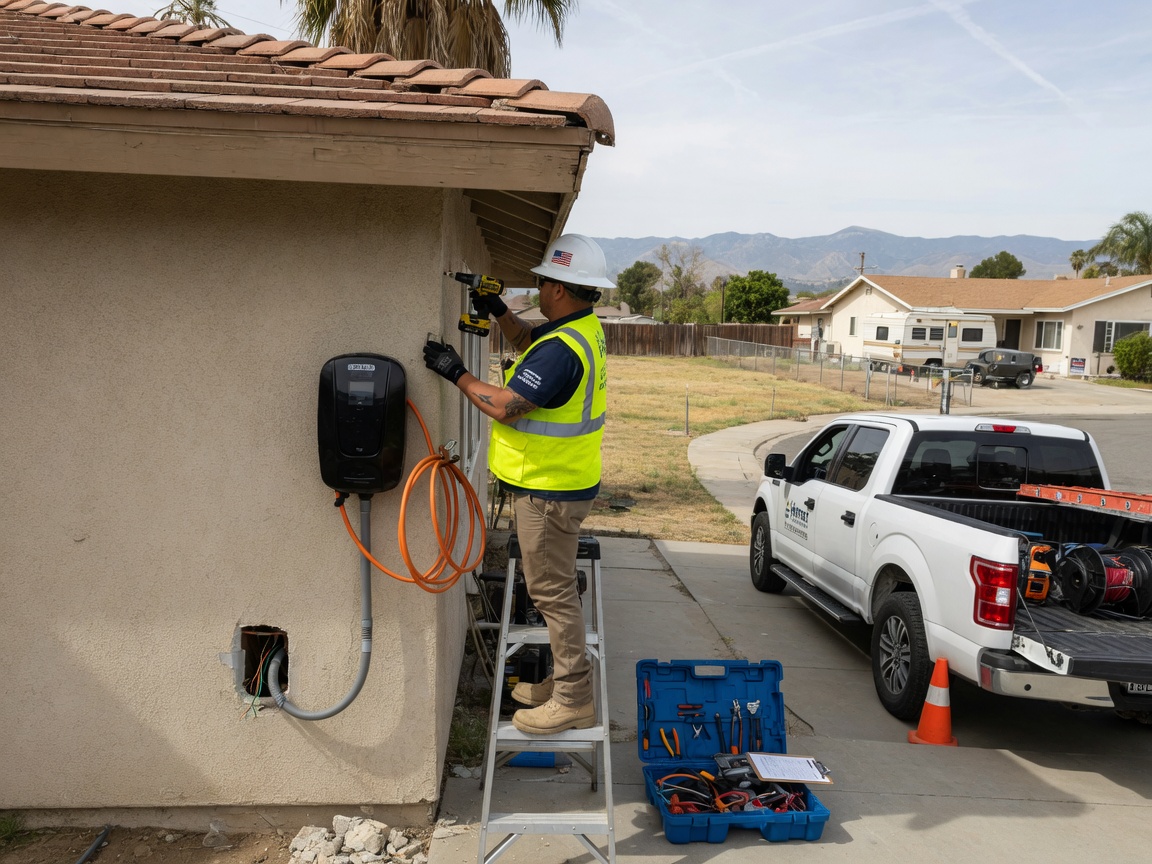
Hemet sits in a hot desert climate where summer temperatures regularly exceed 100 degrees, so EV chargers installed outdoors near Westfield Mall or Ramona Bowl need weatherproof enclosures and proper ventilation to prevent overheating. Homes in Ramona Hills and East Hemet often date from the 1960s through 1980s with 100-amp panels that cannot support a 240-volt Level 2 charger without an upgrade or subpanel addition. Riverside County requires permits and inspections for any new circuit over 40 amps, and crews must account for dust accumulation that can affect connections over time.
Terrain around Diamond Valley Lake and West Hemet includes rocky soil and occasional slopes that increase trenching costs when running conduit from the panel to a garage or driveway charger location. Electricians at Hemet Electric Company Inc start every job with a load calculation on the existing service to avoid nuisance trips during peak summer air-conditioning use. In neighborhoods like Downtown Hemet, aluminum wiring in older homes demands special connectors and torque verification before adding the high-draw charger circuit.
Nearby cities such as San Jacinto and Menifee share the same grid constraints, so installations frequently include a dedicated 60-amp breaker and 6-gauge copper wire rated for the continuous load. Technicians also verify that the charger’s NEMA 14-50 or hardwired connection meets current NEC articles adopted by Riverside County to prevent future inspection failures.
Technician insight
In Hemet the thing that catches most people out with EV Charger Installation is the combination of 100-degree summers and 1960s aluminum wiring in Ramona Hills homes. The extra heat derates the wire and the aluminum connections loosen over time, so we always pull new copper and torque every lug before the charger goes live.
East Hemet garage charger on 100-amp service
Homeowner in East Hemet wanted a Level 2 charger but the panel was maxed by AC and well pump. We found aluminum branch wiring and calculated zero spare capacity. We added a 100-amp subpanel with new copper feeder and installed the charger on a dedicated 60-amp circuit that passed county inspection the same week.
EV Charger Installation Services We Offer
✓Level 2 Residential Charger Installation
Hardwired 240-volt charger setup with dedicated circuit sized for Hemet homes that need panel capacity checks before adding EV load.
✓Outdoor Weatherproof Charger Mounting
Installation of NEMA 4X enclosures and heat-rated conduit runs suited to Hemet’s extreme summer temperatures and blowing dust.
✓Panel Upgrade for EV Charger
Replacement or addition of subpanels in older Ramona Hills and East Hemet homes to safely support 40- to 60-amp EV circuits.
✓Commercial Fleet Charger Install
Multi-unit charger wiring and load management for small businesses serving customers from Temecula and Menifee corridors.
✓Permit and Inspection Coordination
Handling Riverside County electrical permits and scheduling inspections so the finished EV charger passes on first visit.
EV Charger Installation Cost in Hemet, CA
| Service | Typical Range | What Affects It |
|---|---|---|
| Basic Level 2 hardwired install | $900–$1,600 | Depends on panel proximity and existing breaker space. |
| Panel upgrade plus charger | $2,200–$3,800 | Common in 1960s–1980s homes in Ramona Hills. |
| Outdoor trenching and conduit | $450–$950 | Varies with distance and rocky soil near Diamond Valley Lake. |
| Permit and inspection package | $150–$300 | Riverside County fees included. |
Ranges are typical for Hemet, CA and confirmed with an exact written quote before any work starts.
How it works
- 1
Site Assessment
Technician visits the Hemet property to check panel age, available amperage, and route options considering local soil and heat exposure.
- 2
Load Calculation
Review of existing circuits and air-conditioning demand to confirm the charger will not overload service during peak summer use.
- 3
Permit Submission
Preparation and filing of required Riverside County documents before any wiring begins.
- 4
Installation And Test
Mount charger, run conduit, terminate wiring, then verify voltage drop and GFCI protection before final inspection.
Pricing
Upfront quotes after on-site panel and route evaluation.